
The Union Budget for the fiscal year 2026-27 was presented by Finance Minister Nirmala Sitharaman on February 1st, 2026.
This annual financial statement outlines the government’s revenue, expenditure, taxation, and policy priorities for the upcoming fiscal year, playing a pivotal role in shaping the country's economic direction.
The Union Budget is an important topic for all upcoming Kerala PSC exams (KAS, Degree Level, 10th/Plus Two Level) and UPSC exams.
This year’s budget is historic not only for its content but also for its timing, as it is the first-ever Union Budget to be presented on a Sunday.
Quick Facts
- First Union Budget presented on a Sunday.
- 9th consecutive budget presented by Nirmala Sitharaman.
- The Finance Minister who presented the Sunday Budget – Nirmala Sitharaman.
- First budget prepared in the newly inaugurated Kartavya Bhawan.
- Fiscal Deficit Target – 4.3% of GDP for 2026-27 (down from 4.4% the previous year).
- Total Budget Outlay – ₹53.5 Lakh Crore.
- Revenue Deficit – 1.8% of GDP.
- Capital Expenditure (CapEx) – ₹12.2 Lakh Crore (increased by 9%).
- Net Tax Receipts – ₹28.7 Lakh Crore.
- Rupee Comes From (Receipts) –
- Income Tax – 24%
- Borrowings & Other Liabilities – 24%
- GST & Other Taxes – 21%
- Corporation Tax – 15%
- Non-Tax Receipts (Dividends/Fees) – 10%
- Union Excise Duties – 6%
- Customs – 4%
- Rupee Goes To (Expenditure) –
- States' Share of Taxes & Duties – 22%
- Interest Payments – 20% (A slight drop, freeing up money for growth)
- Central Sector Schemes – 17%
- Defences – 11%
- Finance Commission & Other Transfers – 8%
- Centrally Sponsored Schemes – 7%
- Pensions – 2%
- Other Expenditures – 7%
- 16th Finance Commission – Vertical tax devolution to States kept at 41% (Kerala’s share increased from 1.925% to 2.382%).
🎯
Did You Know?
Vertical tax devolution: The vertical split of the Union's divisible pool of tax revenue between the Central Government and all State Governments collectively. (the States' share of central taxes is retained at 41% ie, apprx. ₹15,26,255 Crore)
This is the net tax proceeds minus the cost of collection, cesses, and surcharges. Since the Centre has been increasing cesses lately, the actual money states receive may be lower than 41%.
Horizotal tax devolution: The formula-based distribution of the collective 41% tax pool among individual states, which determines each state’s specific slice of the revenue (e.g., Kerala’s share of 2.382%, ie, apprx. ₹36,355 Crore).
The Core Theme: The "Three Kartavyas"
The 2026 Budget is anchored on three "Kartavyas" (Duties) to achieve the vision of Viksit Bharat @2047:
- Accelerate and Sustain Economic Growth: Emphasis on manufacturing and frontier sectors.
- Fulfill Aspirations of the People: Focus on capacity building and making citizens partners in prosperity.
- Sabka Vikas (Inclusion): Access to resources for every family, region, and sector.
Tax Reforms & Income Tax Changes
The biggest highlight is the change in the six-decade-old Income Tax Act, 1961. The new Income Tax Act, 2025, will come into effect on April 1, 2026.
The purpose of this new Act is officially declared as to simplify, modernize, and remove 'obsolete language.'
Key Statutory Changes:
- Sections – reduced from 819 sections to 536 sections.
- Chapters – reduced from 47 to 23.
- New Terminology – The confusing terms 'Assessment Year' & 'Previous Year' are replaced with a single term: 'Tax Year' (commencing April 1).
- Revenue Neutral – The new Act does not change the tax liability but simplifies the process.
Personal Income Tax
There are no changes to the tax slabs or the standard deduction in this budget, but the existing figures are maintained as they are the 'current' rates for the 2026-27 tax year.
New Tax Regime
| Income Slab | Tax Rate |
|---|---|
| Up to ₹4,00,000 | Nil |
| ₹4,00,001 – ₹8,00,000 | 5% |
| ₹8,00,001 – ₹12,00,000 | 10% |
| ₹12,00,001 – ₹16,00,000 | 15% |
| ₹16,00,001 – ₹20,00,000 | 20% |
| ₹20,00,001 – ₹24,00,000 | 25% |
| Above ₹24,00,000 | 30% |
The Standard Deduction remains at ₹75,000 for salaried individuals. Due to the Section 87A rebate and standard deduction, a salaried person earning up to ₹12.75 Lakh pays ZERO tax under the new regime.
The deadline to file revised or belated I-T returns has been extended to March 31 (from December 31).
Market & Corporate Tax Reforms
Major changes took place in the market sector. They are:
- MAT (Minimum Alternate Tax) – reduced from 15% to 14%. It is now a 'Final Tax' for companies opting for the new regime.
- STT (Securities Transaction Tax) –
- On Futures – Increased from 0.02% to 0.05%.
- On Options – Increased from 0.1% to 0.15%.
- Share Buybacks – now taxed as Capital Gains in the hands of shareholders (previously taxed at the company level).
- TCS (Tax Collection at Source) Relief –
- Foreign Tour Packages – reduced from 5% (or 20%) to a flat 2%.
- LRS (Education/Medical) – reduced from 5% to 2% for remittances over ₹10 Lakh.
- Sale of Scrap / Minerals – reduced to 2%.
What's Cheaper & What's Costlier?
This section reflects the government's push for 'Make in India' and affordable healthcare.
| Category | CHEAPER (Customs Duty Cut) | COSTLIER (Duty/Tax Hike) |
|---|---|---|
| Health | 17 Cancer Drugs & 7 Rare Disease meds. | — |
| Consumer | Mobile Phones, Tablets, & Microwaves. | Luxury Watches & High-end Cameras. |
| Travel/Edu | Foreign Tours & Foreign Education (TCS 2%). | — |
| Lifestyle | Personal Imports (Duty cut 20% to 10%). | Alcohol & Cigarettes (Sin Goods). |
| Green Tech | EV Batteries & Solar Panel glass. | — |
| Misc. | Leather & Footwear inputs. | Stock Trading (F&O), ATM parts. |
Key New Schemes & Initiatives
Below is the list of New schemes and initiatives announced in the Union Budget 2026-27 across key sectors that will drive growth, employment, and inclusive development.
Agriculture & Rural Development
Bharat-VISTAAR
- Full Form – Virtually Integrated System to Access Agricultural Resources.
- A multilingual AI-powered platform for farmers.
- Function: It integrates AgriStack (digital public infrastructure) with ICAR (Indian Council of Agricultural Research) advisory services.
- Budget – ₹150 crore for the initial phase (2026-27).
Other initiatives
- Coconut Promotion Scheme: India is the world’s largest producer of coconuts. This scheme focuses on replacing old, non-productive trees with high-yielding varieties.
- Cashew & Cocoa Mission: A dedicated program to make India self-reliant in raw cashew/cocoa and transform them into global brands by 2030.
- Sandalwood Revival: A partnership with state governments to restore the "Indian Sandalwood ecosystem" through focused cultivation and processing.
- Amrit Sarovars for Fisheries: 500 reservoirs and Amrit Sarovars will be integrated into the fisheries value chain, involving women-led groups and startups.
- Veterinary Expansion: A loan-linked subsidy scheme to establish private veterinary colleges and hospitals, aiming to add 20,000 more professionals to the sector.
Manufacturing Sector
Biopharma SHAKTI
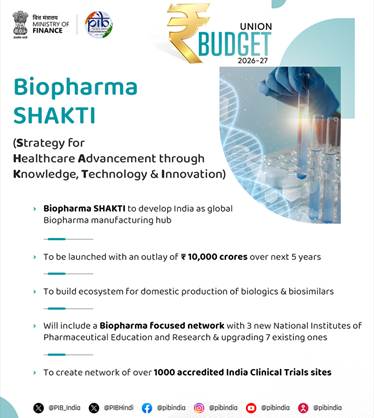
- Full Form – Strategy for Healthcare Advancement through Knowledge, Technology & Innovation.
- Outlay – ₹10,000 crore over 5 years.
- Aim – To make India a global hub for biologics and biosimilars.
Aims to establish 3 new NIPERs (National Institutes of Pharmaceutical Education and Research) and to upgrade 7 existing ones.
For clinical research purposes, the creation of a network of 1,000+ accredited clinical trial sites is also proposed.
Rare Earth Corridors
- Aim – Establishment of dedicated industrial clusters/corridors for mining, processing, and manufacturing of rare earth minerals.
- Partner States – Kerala, Odisha, Andhra Pradesh & Tamil Nadu.
It also seeks to strengthen domestic supply chains for critical minerals needed for clean energy and advanced manufacturing, thus reducing dependency on imports for EV magnets and defense tech.
India Semiconductor Mission (ISM) 2.0
The second phase of the mission will focus on producing semiconductor equipment and materials and creating a "full-stack Indian IP."
Carbon Capture, Utilization, and Storage (CCUS) Scheme
It is a landmark initiative from the Union Budget 2026-27 with an outlay of ₹20,000 crore designed to decarbonize 'hard-to-abate' sectors like steel, cement, and power.
It aims to capture CO2 emissions at the source and either store them safely in deep geological formations or reuse them as a resource to produce valuable products like methanol, urea, and synthetic fuels.
By bridging the gap between laboratory research and large-scale industrial use, the scheme acts as a critical pillar for India to achieve its Net Zero 2070 target.
Other initiatives
- Container Manufacturing Scheme: Outlay of ₹10,000 crore over 5 years aimed at ending the global shortage of shipping containers and making India a logistics hub.
- CIE Enhancement Scheme: A new scheme for Construction and Infrastructure Equipment (CIE) to locally manufacture tunnel-boring machines, high-speed lifts, and firefighting gear.
- SME Growth Fund: A ₹10,000 crore fund to provide equity-based investment to high-potential 'Champion MSMEs.'
- Corporate Mitra: A new cadre of trained para-professionals to help small units in Tier-II and Tier-III towns manage regulatory compliance at low costs.
- Dedicated Chemical Parks: Support for states to establish 3 dedicated Chemical Parks through a 'Challenge Route' (competitive bidding among states).
Frontier Technology & Strategic Sectors
The 2026-27 Budget signals a decisive shift from policy intent to operational execution in deep-tech sectors.
1. National Quantum Mission (NQM) & Quanta 2026
The allocation for NQM has been increased to ₹900 crore (a 50% jump from the ₹600 crore estimated last year).
- Quanta 2026 – A new strategic roadmap launched to accelerate the indigenous development of quantum processors and secure communication.
- Thematic Hubs (T-Hubs) – Four specialized hubs (Quantum Computing, Communication, Sensing, and Materials) are now fully functional as Section-8 companies.
- Key Target – The mission is entering its 'Year 3' milestone, aiming to demonstrate intermediate-scale quantum computers (20-50 physical qubits) and satellite-based secure communications over 2,000 km.
2. Space Economy: From Research to Realization
- Department of Space (DoS) Outlay – Allocated ₹13,705.6 crore, representing a 10% rise over revised estimates.
- Space VC Fund – Out of the ₹1,000 crore Venture Capital Fund, ₹250 crore is earmarked for deployment in FY 2026-27 to support nearly 40 space-tech startups.
- Planetary Science Push – A significant focus on astrophysics with the upgrade of four major facilities:
- National Large Solar Telescope (for solar research).
- National Large Optical Infrared Telescope.
- Himalayan Chandra Telescope.
- COSMOS 2 Planetarium.
- Strategic Goal – To increase India’s share in the global space economy to 10% by 2030.
3. Data Centers & Cloud Sovereignty
The 2026 Budget elevates data centers from 'buildings with servers' to 'Strategic National Infrastructure.'
- The 2047 Tax Holiday – In a landmark move, a tax holiday until 2047 is proposed for foreign companies providing global cloud services, provided they use specified data centers located in India.
- Data-in-India Mandate – To qualify for tax benefits, these global firms must route services for Indian customers through an Indian reseller entity. This is a strategic push for 'Data Sovereignty.'
- Safe Harbour Rules – A common safe harbour margin of 15% on cost has been introduced for Indian entities providing data center services to their foreign related parties, significantly reducing tax litigation.
- AI-Ready Infrastructure – The budget allocates support for sourcing 40,000 GPUs (Graphics Processing Units) to be hosted in these data centers to power Indian AI startups.
- Green Power Linkage – To address the high energy needs of these hubs, the budget waives customs duty on capital goods for Battery Energy Storage Systems (BESS) and emphasizes Nuclear Small Modular Reactors (SMRs) as a 'base load' for data parks.
Textile Sector
The Textile Sector is given a high-level priority in the Union budget 2026-27 because it is the second-largest employer in India after agriculture.
In the Budget 2026-27, Finance Minister Nirmala Sitharaman proposed an Integrated Programme for the Textile Sector featuring five pillars.
These schemes are designed to move India from traditional manufacturing to a high-tech, sustainable global hub. They are:
- National Fibre Scheme
- Textile Expansion and Employment Scheme
- National Handloom and Handicraft Scheme
- Tex-Eco Initiative
- Samarth 2.0
1. National Fibre Scheme
The core objective of this scheme is to achieve Aatmanirbharta (Self-reliance) in the raw material stage of the textile value chain.
It covers the entire spectrum of fibres:
- Natural Fibres: Boosting production and quality of Silk, Wool, and Jute.
- Man-made Fibres (MMF): Enhancing capacity for polyester and nylon.
- New-age/Technical Fibres: Focus on industrial-age fibres used in meditech, geotech, and protective gear.
2. Textile Expansion and Employment Scheme
Its core objective is to modernize the traditional textile clusters to make them globally competitive through capital support for machinery, technology upgradation, and the establishment of common testing and certification centres.
It also aims to generate large-scale jobs in rural and semi-urban areas.
3. National Handloom and Handicraft Programme (NHHP)
This scheme aims to integrate and strengthen all existing fragmented schemes for weavers and artisans.
It works in tandem with the newly announced Mahatma Gandhi Gram Swaraj Initiative for branding and global market linkages.
🎯
Mahatma Gandhi Gram Swaraj Initiative
A new initiative was launched to strengthen Khadi, Handloom, and Handicrafts. It aims at global market linkage and modern branding for traditional rural industries.
4. Tex-Eco Initiative
In context with the EU and USA implementing strict environmental norms (like the Carbon Border Adjustment Mechanism), Indian textiles also need to be 'eco-certified.'
Thus, it aims to promote globally competitive, environmentally sustainable textiles and apparel manufacturing by:
- Incentivizing factories that use renewable energy and zero-liquid discharge systems.
- Promoting circularity (recycling old clothes into new fibre).
- Aligning Indian products with international 'Green Market' opportunities.
5. Samarth 2.0
The core objective is to upgrade the skilling ecosystem for the next generation of textile workers.
The Samarth 2.0 moves beyond basic stitching skills to tech-heavy training by initiating a deeper collaboration between Industry and Academic Institutions and focusing on Technical Textiles and digital manufacturing tools (AI and IoT in textiles).
Infrastructure
Railways
The most talked-about highlight is the announcement of 7 High-Speed Rail Corridors (Bullet Train routes) spanning 4,000 km with a projected investment of ₹16 lakh crore.
New Announced 7 High-Speed Rail Corridors
- Mumbai – Pune (45 mins travel time)
- Pune – Hyderabad
- Hyderabad – Bengaluru
- Hyderabad – Chennai
- Chennai – Bengaluru (1.5 hours travel time)
- Delhi – Varanasi
- Varanasi – Siliguri
Another ₹1.2 lakh crore is earmarked specifically for safety, including the rapid rollout of the Kavach (Automatic Train Protection) system.
A new Dedicated Freight Corridor (DFC), the East-West DFC linking Dankuni (West Bengal) to Surat (Gujarat) to slash logistics costs, was also allocated in the Union Budget 2026-27.
Urban Infrastructure: City Economic Regions (CER)
Under the CER Scheme, the government will identify and develop City Economic Regions. Each CER will receive a grant of ₹5,000 crore over five years.
But this funding isn't a direct handout; cities must compete via a 'challenge mode' based on their reform-cum-results performance in urban planning and infrastructure.
The main focus areas for modernizing basic amenities and creating 'faith-based economic ecosystems' are in cities like Ayodhya, Varanasi, and Madurai.
Logistics & Waterways
- 20 New National Waterways – To be operationalized over the next 5 years to move bulk cargo sustainably.
- Coastal Cargo Promotion Scheme – A new subsidy-linked program to encourage industries to shift freight from road/rail to coastal shipping.
Infrastructure Risk Guarantee Fund
To encourage private companies to build more, the government introduced the Infrastructure Risk Guarantee Fund.
This fund provides partial credit guarantees to lenders during the high-risk construction phase, making it easier for projects to get bank loans at lower interest rates.
Education, Employment & Services Sector
Educational Sector
The government is moving beyond classrooms to create integrated live-learn ecosystems.
- University Townships – Five university townships will be created in the industrial and logistic corridors. These zones will host universities, colleges, and research institutions alongside residential complexes to integrate learning with industry.
- AVGC Content Creator Labs – To boost the Orange Economy, labs will be set up in 15,000 secondary schools and 500 colleges. These will be spearheaded by the Indian Institute of Creative Technologies (IICT), Mumbai.
- IP-Backed Lending – A revolutionary move allowing creators to use their Copyrights/Patents as collateral for bank loans instead of physical land or gold.
- NID Eastern Region – A new National Institute of Design (NID) will be established in East India via a Challenge Route to promote design education.
🎯
Orange Economy (aka Creative Economy)
An economic sector where the primary value is derived from human creativity, culture, and intellectual property (IP) rather than physical manufacturing or natural resources.
Coined from the famous book 'The Orange Economy: An Infinite Opportunity' by Iván Duque and Felipe Buitrago.
The Union Budget 2026-27 specifically highlights:
- AVGC-XR: Animation, Visual Effects, Gaming, Comics, and Extended Reality.
- Digital Content: Podcasts, YouTube/social media creation, and OTT platforms.
- Design & Fashion: Graphic design, architecture, and luxury apparel.
- Live Entertainment: Music concerts (the "Concert Economy"), theater, and festivals.
- Heritage & Tourism: Experiential cultural destinations and traditional handicrafts.
Medical & Traditional Education
To meet the soaring global demand for traditional medicine, the Budget proposes a massive institutional scale-up.
3 new All India Institutes of Ayurveda (AIIA) are allocated in the budget. Currently all major AIIAs are in New Delhi and Goa. Adding three more is a strategic move to turn India into a global hub for the 'Wellness Economy.'
Envisioned on the lines of premier national institutions (like AIIMS), these will be established to provide advanced research, postgraduate education, and tertiary healthcare services.
These new institutes will work in synergy with the WHO Global Traditional Medicine Centre (Jamnagar) to bolster evidence-based research.
A scheme to modernize AYUSH pharmacies and drug testing laboratories to ensure international certification standards for Ayurvedic products is also there.
The budget also proposes 5 Regional Medical Value Tourism Hubs where Ayurveda will be a core Service Export.
A scheme to modernize AYUSH pharmacies and drug testing laboratories to ensure international certification standards for Ayurvedic products is also there.
The budget also proposes 5 Regional Medical Value Tourism Hubs where Ayurveda will be a core Service Export.
Turtle Trails: The Union Budget 2026-27 proposed developing 'Turtle Trails' along key nesting sites in Kerala, Odisha, and Karnataka to promote ecologically sustainable eco-tourism.
Employment & Skilling
- PM SETU – The flagship Pradhan Mantri Skilling and Employability Transformation through Upgraded ITIs (PM SETU) received a massive boost (₹6,140.50 crore) to modernize Industrial Training Institutes.
- E3 Standing Committee – A high-powered Education to Employment and Enterprise (E3) Standing Committee will be formed. Its goal is to recommend measures to make India a global leader in services, targeting a 10% global share by 2047.
- Allied Health Professionals (AHP) – A plan to add 100,000 AHPs over the next five years by upgrading existing institutions and setting up new ones in both private and government sectors
Services Sector: IT & Creative Power
The services sector is being positioned as the primary engine for Viksit Bharat.
Software development, IT-enabled services (ITeS), KPO, and contract R&D are now merged into a single 'Information Technology Services' category.
The safe harbour margin is set at 15.5%, and the threshold for automated approval has been raised to ₹2,000 crore.
- Overseas Education Relief – For families with students abroad, the Tax Collected at Source (TCS) on overseas education remittances under the Liberalised Remittance Scheme (LRS) has been reduced from 5% to 2%.
- Astrophysics Promotion – Four telescope infrastructure facilities (including the National Large Solar Telescope) will be upgraded to promote Astro-Tourism and scientific research services.
Services & Retail Sector: Women Empowerment
In the 2026-27 Union Budget, the government specifically moved away from viewing women's groups as just 'welfare beneficiaries.'
Instead, they are being integrated into the Services and Retail Economy as professional entrepreneurs.
SHE Marts (Self Help Entertainment Marts)
Previously, schemes like Lakhpati Didi focused on 'income generation' (e.g., tailoring at home).
SHE Marts transform this into 'Enterprise Ownership.' Women are now considered as 'Service Providers' and 'Retail Managers,' not just laborers.
SideNotes:
- Chairman of 16th Finance Commission – Dr. Arvind Panagariya.





Post a Comment
Post a Comment